What you get each week
One email. That's all, no spam, nothing extra. In it:
- The week's passages, plus a daily reading of 10–20 verses
- Reflection questions to help you, or your family, engage
- A few bonus emails at the end of the year to help you start strong
Each study comes as two PDFs: one for viewing on a screen, and a booklet for printing. Print the booklet double-sided, flipping on the long edge. There's no online version yet (I like pen and paper for this kind of thing), but you can load the regular PDF into a viewer and type into it if that's more your style.
What's in a week's study
A page-by-page walk through the booklet, for anyone who hasn't used one before.
The cover
The first page has the weekly reading. This is for those who want to read through the entire Bible in a year: check off all the passages for each of the 52 studies and you'll have done just that. There are five blocks of passages, each with about the same number of verses, so they double as a daily reading plan. Why five and not seven? To make it easy to catch up if you miss a day.
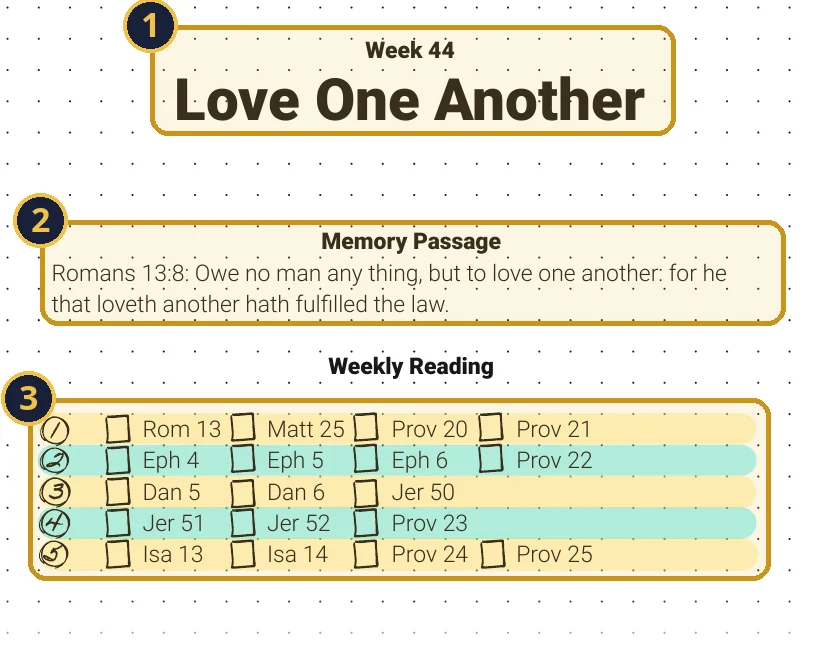
- The week's number and title.
- The memory passage.
- The weekly reading: five blocks of passages, a checkbox for each.
The daily studies
Five single-page studies, each on a passage of around 15–20 verses. They're designed for daily study, on your own or with a group (we use them for family devotions). On purpose, they don't match the daily readings on the cover, but they are all drawn from the week's passages. So a parent reading through in a year and kids doing the daily studies may not read the same passage on the same day, but by the end of the week they'll have read the same things.
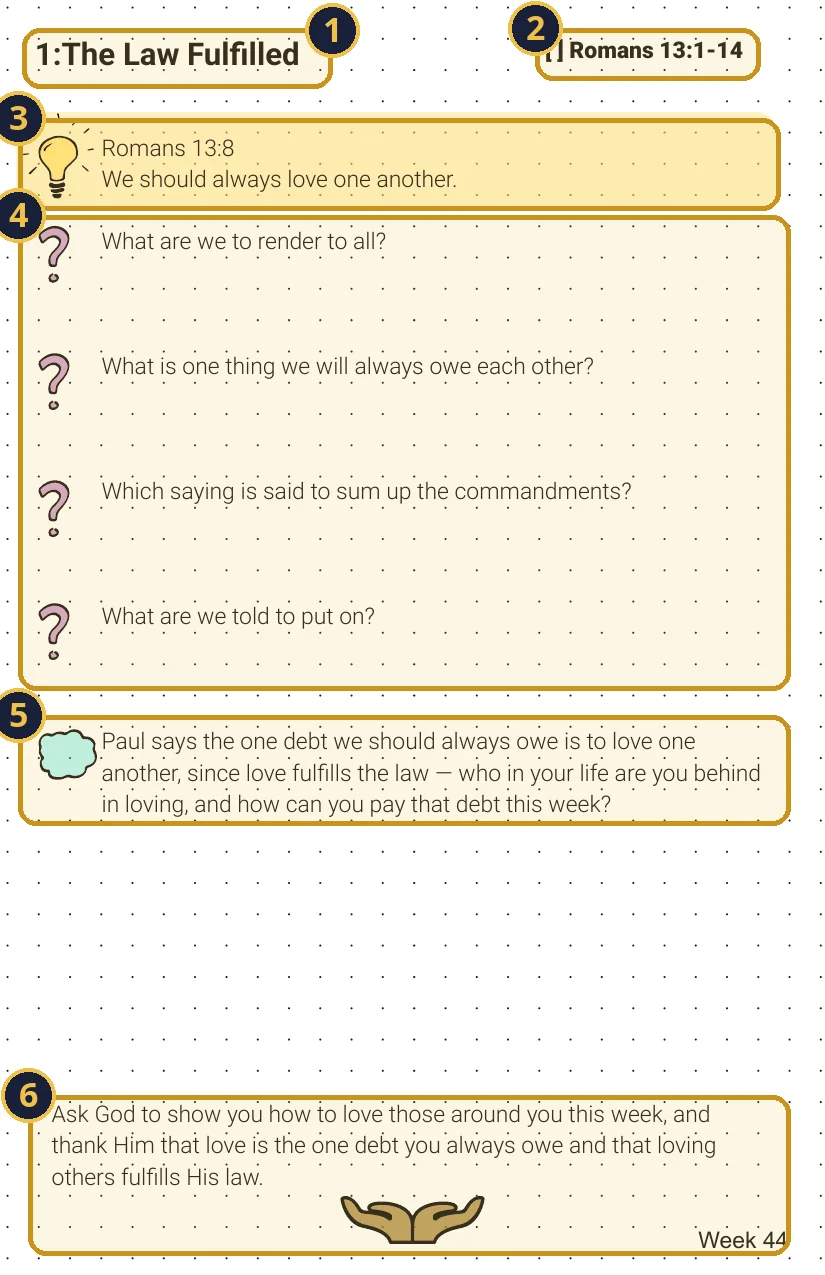
- The study's title.
- The passage, usually 15–20 verses.
- The big idea, for younger listeners.
- Four retention questions.
- The thought-provoking question.
- The prayer prompt.
The first study
This year, the first study every week is the next chapter in this set: Genesis 1–9, Genesis 11, John, Romans, James. That chapter is also the first chapter in the first day's reading on the cover (yes, the one exception to the "they don't match up" rule). If you're new to studying the Bible, this is your lane: a single chapter each week.
The questions
Each study has four retention questions. They're not trick questions (if one is, I made a mistake); they're there to make you think a bit about what you just read. We ask them right after reading the passage in family devotions. Then there's one thought-provoking question. Also not a trick, just one without a specific answer, to help you think about what the passage might mean to you. Finally, a prayer prompt, to encourage you to pray the passage you just read.
The big idea
There's a light bulb at the top of each study. It's for younger listeners: a single verse and a single big idea from that verse. If twenty verses is too much, focus on the big idea.
The last page
On the back is a set of questions you can use to review the week, or as prompts to start conversations in a group. We use these every week in Sunday school.
Joining partway through the year
That's fine. Don't say you'll wait and start fresh in January. Jump in with this week's study. The people around you who are already doing this are on the same page, literally, and that's the whole point. And if you miss a week, that's okay. The goal is to study together, not to get all the stars on your reading chart.
If you're the kind of person who really wants to start at Week 1: when this year's 52 studies are done, the whole set will be available as a single download. So do the rest of this year with us, then start this year's study over from Week 1 in January. By the time you get back to the weeks you've already done it'll be ten months later, and let's be honest, you're not going to remember. Nobody's keeping score.
Next year's study, assuming I do it again, will go out weekly like this one, because I write it as the year goes. So you can do that one with everybody as it comes out, or work through this year's complete set on your own schedule. Or both. The point is you're reading, and reading what the people around you are reading.
Share it, then talk about it
Invite someone you know who studies the Bible, and someone who doesn't. Then, and this is the key part, talk about it with both of them. That's why I'm doing this: a plan that works for someone reading a single chapter a week and someone reading through the Bible in a year, so they'll both have read the same thing and have something to talk about.
A work in progress
This is my third year putting it together, so you're getting a much more refined version than the first one. There are still things I'm working out, which is why each year's set only becomes a full download once the year is finished. Don't be surprised when things change a little (hopefully for the better), and feel free to tell me what would be better for you. Seriously.